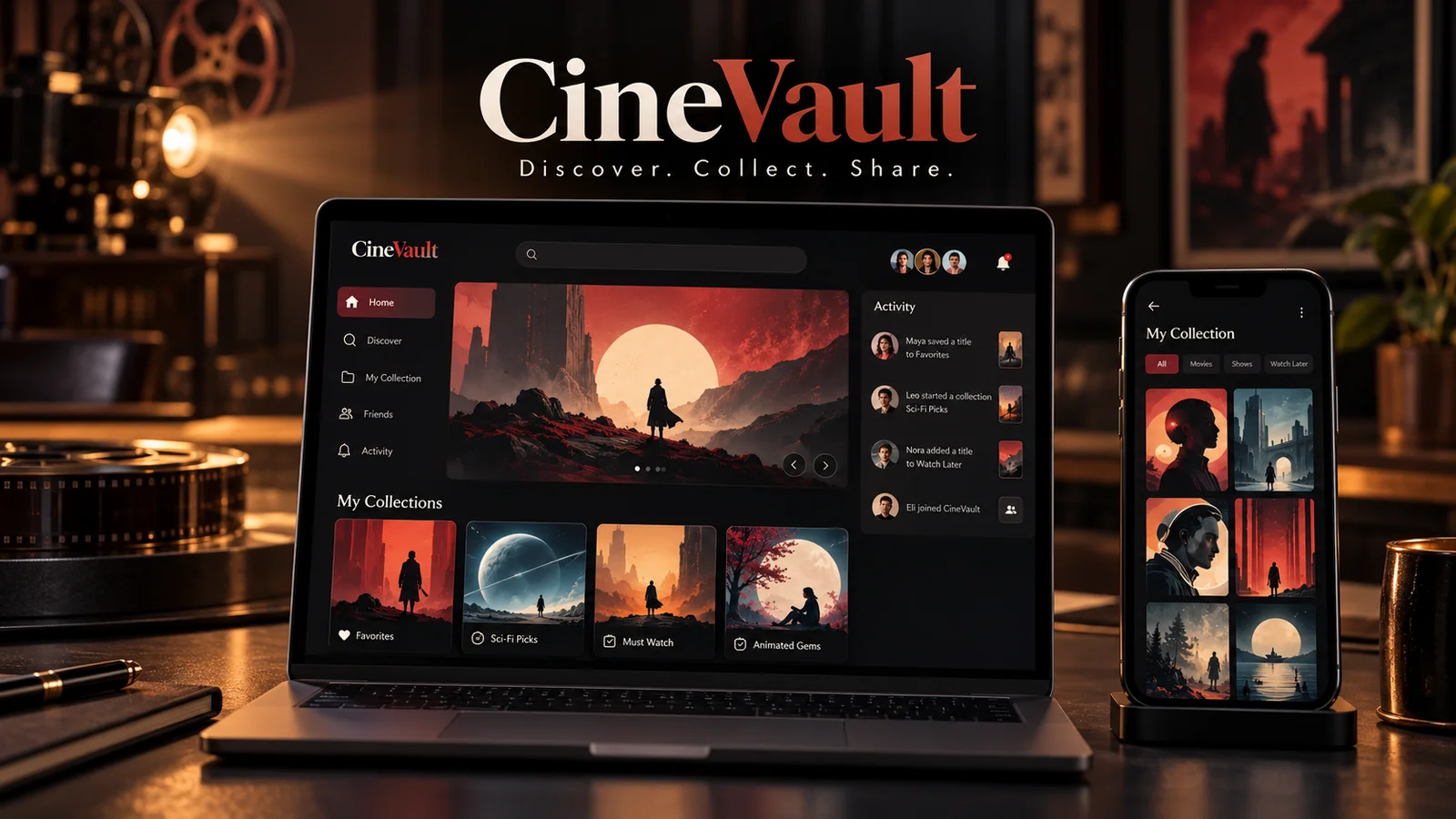
CineVault
An entertainment and social product for tracking media and sharing collections.
- Status
- In progress
- Platforms
- Web, Backend
Key Challenges
- Modeling collections, follows, saved content, and collaboration without duplicating externally sourced media metadata.
- Coordinating cached remote data, local interaction state, and live social notifications.
- Persisting drag-and-drop collection order while keeping membership and ownership rules in the backend.
Key Learnings
- Separating product-owned relational data from third-party discovery metadata.
- Using server-state caching and client-state stores for different responsibilities.
- Connecting refresh-token sessions, Redis-backed infrastructure, and user-specific real-time events.
Overview
CineVault is my personal entertainment and social product for discovering media, maintaining a personal library, and sharing collections. I built the Next.js frontend and modular Express backend, including authentication, media tracking, collection management, social relationships, and collaboration.
Key Features
Media Discovery and Tracking
Connect external media discovery to user-owned media entries and a personal entertainment library.
Collections and Ordering
Organize media into collections, manage collection items, and use drag-and-drop interactions to persist their order.
Social Relationships
Follow other users and connect social activity to saved content and notifications.
Collection Collaboration
Model collaborative collections and their participants separately from personal library entries.
Personal Notifications
Use authenticated Socket.IO rooms to deliver events to the relevant user rather than broadcasting all activity to every client.
Technical Implementation
The Next.js/React frontend uses TypeScript, TanStack Query for server data, and Zustand for local interaction state. A modular Express API handles product operations; Prisma maps the PostgreSQL schema for users, media entries, collections, follows, saved content, and collaboration.
- Relational persistence: Collection items and social relationships are product-owned database records, distinct from TMDB metadata.
- Remote data: TanStack Query coordinates fetching and cache updates for API-backed screens.
- Client state: Zustand keeps transient UI state separate from persisted server records.
- Interactions: Drag-and-drop collection management connects UI ordering to backend persistence.
- Authentication: JWT refresh flows support authenticated sessions.
- Infrastructure: Redis supports caching and the Socket.IO adapter; Cloudinary handles media uploads.
Architecture and Tradeoffs
External media lookup and local social state change for different reasons. Keeping them separate prevents a third-party catalog response from becoming the authority for user-created collection membership or collaboration. Server-data caching and local UI state also have different lifecycles, so they use separate tools.
Real-Time Updates and Session Handling
Personal Socket.IO rooms target notifications to the intended recipient. The Redis adapter coordinates socket events, while session and cache handling remain backend responsibilities. Client events complement persisted API state rather than replacing authorization or database records.
Have a project or opportunity in mind?
Let's discuss employment opportunities or freelance work.
Contact Kunj